
Transaction Level Modeling (TLM) is a communication mechanism where data is transferred as transactions (objects) instead of individual signals.
In UVM, a transaction is usually a sequence item that contains multiple fields such as address, data, control bits, etc.
Without TLM (Signal Level)
- Too many signals
- Tight coupling between components
- Poor reusability
With TLM (Transaction Level)
- Fewer connections
- Loose coupling
- Clean and reusable architecture
Why Do We Need TLM?
TLM helps to:
- Simplify communication between UVM components
- Separate data generation, driving, and checking
- Enable scalable and maintainable testbenches
- Improve simulation performance
All modern UVM environments use TLM-based communication.
Basic TLM Building Blocks in UVM
TLM communication uses five basic elements:
- Port – Initiates a transaction
- Export – Forwards a transaction
- Implementation (imp) – Implements the actual method
- TLM FIFOs
- Set Of Methods
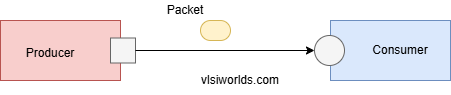
What is TLM-1 in UVM?
TLM-1 provides simple, method-based communication between components using function and task calls.
It supports:
- Blocking communication
- Non-blocking communication
- One-way and two-way data transfer
Common TLM-1 Interfaces
put()get()peek()transport()
We will discuss more about interfaces in next chapters.
Blocking vs Non-Blocking
- Blocking: Caller waits until transaction is completed
- Non-Blocking: Caller continues execution immediately
TLM-1 Port Types
| Port Type | Purpose |
|---|---|
uvm_blocking_put_port | Blocking data transfer |
uvm_nonblocking_put_port | Non-blocking data transfer |
uvm_blocking_get_port | Blocking receive |
uvm_nonblocking_get_port | Non-blocking receive |
uvm_transport_port | Request–response |
Typical Usage:
Sequencer → Driver
Driver → Sequencer (response)
What is TLM-2 in UVM?
TLM-2 is a more advanced and standardized transaction modeling approach, inspired by SystemC TLM-2.0.
It is mainly used for:
- High-level modeling
- Memory-mapped transactions
- Timing-accurate communication
Note: In pure UVM testbenches, TLM-1 is used far more frequently than TLM-2.
Key Features of TLM-2
- Standard transaction payload
- Timing annotation support
- Loosely-timed and approximately-timed models
- Better suited for system-level modeling
TLM-2 Interfaces
| Interface | Purpose |
|---|---|
b_transport() | Blocking transport |
nb_transport_fw() | Non-blocking forward path |
nb_transport_bw() | Non-blocking backward path |
TLM-2 Port Types in UVM
- uvm_tlm_b_initiator_socket
- uvm_tlm_b_target_socket
- uvm_tlm_nb_initiator_socket
- uvm_tlm_nb_target_socket
Industry usage: TLM-2 is more common in virtual platforms and architectural models than in pure UVM testbenches.