
In UVM (Universal Verification Methodology), TLM (Transaction Level Modeling) is used to transfer data between components using transactions instead of signals.
To enable this communication, UVM defines three fundamental TLM connection types
Three Types of TLM Connection Objects in UVM:
UVM TLM communication is built using:
- Port
- Export
- Implementation (Imp)
These are not SystemVerilog ports — they are UVM class-based communication objects
TLM Port
A TLM port is used by a component to initiate a transaction.
- Acts as a caller
- Does not implement the method
- Connected during the
connect_phase
uvm_blocking_put_port #(my_txn) put_port;           //unidirectional
uvm_analysis_port      #(my_txn) analysis_port;

uvm_transport_port #(REQ, RSP) trans_port;           //bidirectional
Constructor Method:
trans_port = new(string name, uvm_component parent);Typical Usage
- Sequencer → Driver
- Monitor → Scoreboard
TLM Export
A TLM export acts as a forwarding interface.
- Forwards method calls
- Does not contain implementation logic
- Used when a component is an intermediate connection point
uvm_blocking_put_export #(my_txn) put_export;     //unidirectional

uvm_transport_export #(REQ, RSP) trans_export;     //bidirectional
Constructor Method:
trans_export = new(string name, uvm_component parent);Typical Usage
- Environment forwarding transactions to sub-components
- Hierarchical connections
TLM Implementation (Imp)
A TLM imp provides the actual implementation of TLM methods.
- Implements put(), get(), write(), etc.
- Final transaction consumer
- Must define method behavior
uvm_blocking_put_imp #(my_txn, my_comp) put_imp;      //unidirectional

uvm_transport_imp #(REQ, RSP, IMP) trans_imp;               //bidirectional
REQ → request type
RSP → response type
IMP → component class implementing the method
Constructor Method:
trans_imp = new("trans_imp", this);Picture Representation:
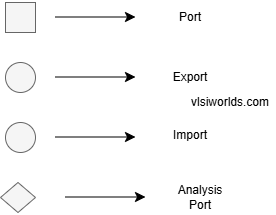
Valid TLM Connections in UVM
UVM enforces strict connection rules to maintain architectural correctness.
| From – To | Valid |
|---|---|
| Port → Export | ✅ Yes |
| Port → Imp | ✅ Yes |
| Export → Export | ✅ Yes |
| Export → Imp | ✅ Yes |
| Port → Port | ✅ Yes (hierarchical forwarding case) |
Invalid Connections:
| From – To | Valid |
|---|---|
| Imp → Port | ❌ No |
| Imp → Export | ❌ No |
| Imp → Imp | ❌ No |
Rule: Calls always flow towards the implementation, never away from it.
Port-to-Port Connection:
This is most commonly seen when connecting a sub-component port to a parent component port, such as driver → agent → environment.
🔹 Method calls must ultimately terminate at an imp.
🔹 Ports may be chained hierarchically to forward calls upward.
Child port → parent port → export/imp → AllowedLet’s understand it through an example.
Driver (child)
uvm_blocking_put_port #(my_txn) drv_put_port;Agent (parent)
uvm_blocking_put_port #(my_txn) agent_put_port;Valid Port-to-Port Connection
// Inside agent.connect_phase()
driver.drv_put_port.connect(agent_put_port);
Later, the agent’s port must connect to an export or imp:
agent.agent_put_port.connect(scoreboard.put_export);If the chain never reaches an imp, UVM will throw a runtime error.
Think of ports as pipes, not endpoints.
Port → Port → Port → Export → ImpAs long as:
- Direction is consistent
- Interface types match
- The chain ends at an
imp
…it is valid UVM TLM.